City Limits rounds up the latest housing and land use-related events, public hearings and upcoming affordable housing lotteries that are ending soon.
Adi Talwar
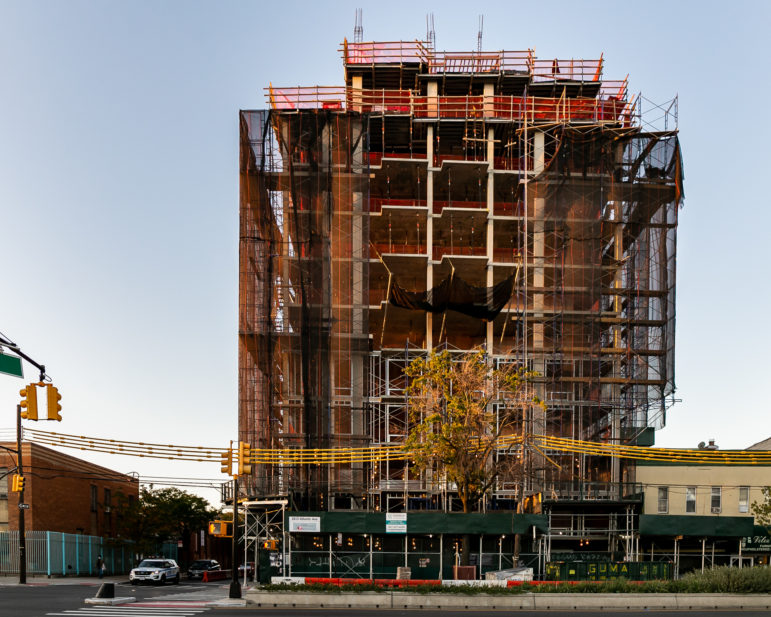
Construction at 2815 Atlantic Ave., Brooklyn, in November 2021.
Welcome to City Limits’ NYC Housing Calendar, a weekly feature where we round up the latest housing and land use-related events and hearings, as well as upcoming affordable housing lotteries that are ending soon. If you know of an event we should include in next week’s calendar, email david@citylimits.org.
To get more resources like this as well as our latest reporting on local housing issues, sign up for City Limits’ Mapping the Future newsletter here.
Upcoming Housing and Land Use-Related Events:
Tuesday, Jan. 3 at 1 p.m.: The NYC Planning Commission will hold a review meeting; the agenda has not yet been posted. More info and the livestream link here.
Tuesday, Jan. 3 at 9:30 a.m.: The Midtown South Community Council will hold a discussion on health, homelessness and housing featuring author Wendell Potter. More here.
Wednesday, Jan. 4 at 10 a.m.: The NYC Planning Commission will hold a public meeting to discuss land-use projects in Manhattan and Brooklyn. More info and the livestream link here.
NYC Affordable Housing Lotteries Ending Soon
The New York City Department of Housing Preservation and Development (HPD) are closing lotteries on the following subsidized buildings over the next week:
Opinion: New York’s Housing Plans Must Address Affordability—& Climate Change
“New York State has the lowest per capita emissions in the country. Compared to the rest of the United States, New York City has by far the best transit, and it is the only city where living car-free is the standard. Other cities should pursue more climate-friendly urban design, but New York City should lead by welcoming more people.”
Adi Talwar
The intersection of Atlantic and East new York avenues, pictured here in 2019. City officials have been eyeing for years for potential economic and real estate development.
New York City desperately needs to address its severe housing crisis. Plans to do so have been released by Mayor Eric Adams and City Council Speaker Adrienne Adams, with Gov. Kathy Hochul expected to soon follow suit. These plans are primarily targeted at affordability. However, climate change should also be front-and-center. Ambitious, well-designed housing plans can provide major benefits for both affordability and climate change while also making the New York City metropolitan area a safer, more pleasant place to live.
New York City’s affordability problem is acute. Thanks to the stratospheric cost of housing, New York was recently tied with Singapore for most expensive city in the world. It is the first time New York City has ever achieved this dubious distinction.
The root of the problem is a massive housing shortage. For decades, New York City zoning laws have restricted new construction. That wasn’t a problem in the 1970s, when the city was losing population. However, the population has grown every decade since the 1980s and now has one million more people than its prior postwar peak. The affordability crisis is a matter of basic economics: the housing supply doesn’t meet the demand, so prices go up.
Public policy is currently restricting the local housing supply. There is a strong moral argument that policy should instead push the housing supply in the opposite direction. The reason for this is climate change.
Climate change is a quintessential example of a market failure. When people emit greenhouse gas, they exacerbate climate change, causing harms around the world. Heat waves in New York City, flooding in Pakistan, extreme weather across Africa and China—all of this and more is worsened by climate change. As the planet heats up, the harms become increasingly catastrophic. Those who cause the emissions are generally not required to pay for the harms; that is the market failure. It creates a moral responsibility for those who are able to reduce emissions.
Housing is one of the most important ways to reduce emissions. (Other important ways include clean energy, plant-based diets, and avoiding plane flights.) Small apartments require less energy than large, detached single-family houses. High population density also facilitates efficient transportation with walking, biking, and transit instead of private automobiles.
New York State has the lowest per capita emissions out of any state in the country. Compared to the rest of the United States, New York City has by far the best transit, and it is the only city where living car-free is the standard. Other cities should pursue more climate-friendly urban design, but New York City should lead by welcoming more people.
The housing shortage makes it a luxury to live in New York City. However, because of climate change, it should be a luxury to not live in New York City. It should be more expensive to live in car-centric sprawl than it is to live in one of the the most energy-efficient cities in the country.
It is difficult to put an upper limit on how much housing should be built in the New York City metro area. Mayor Eric Adams’ plan calls for 500,000 new units over the next 10 years. Adams calls this a “moonshot goal,” but it’s probably much too small.
For perspective, New York City added 630,000 people during the 2010s despite the severely constrained housing market. Meanwhile, the U.S. population is projected to grow about the same over the next decade as it did over the previous. The dual goals of affordability and climate change mean that New York City should plan for significantly more population growth in the upcoming decade. So too should the rest of the metropolitan area, especially Long Island, the lower Hudson valley, and southwestern Connecticut, all of which have been especially derelict in housing construction.
One might object that there isn’t enough space for so many people. That’s incorrect. There’s plenty of space; it’s just not being used well. Plans should focus on increasing density, especially near transit. Thanks to the rise of work-from-home, transit lines are currently running well below their pre-pandemic peaks. The cash-strapped transit agencies need new riders.
To ensure adequate open space for all residents, public street space should be reclaimed from private automobiles and used for local communities. The popular Open Streets program should be expanded. Planners should also study global best practices, such as Barcelona’s Superblocks. New York City should commit to ending the scourge of car culture, which inhibits people from imagining better uses of public streets.
Changes to public street design should accompany bold housing plans to build a cleaner, safer, more pleasant, and more affordable New York City metropolitan area. A better city is possible, if only there is the ambition to build it.
Baum is executive director of the Global Catastrophic Risk Institute.
As 2022 comes to a close, City Limits looks back at images that defined some of New York City’s biggest news stories and most pressing policy issues. Below are some of our favorite photos published this year.
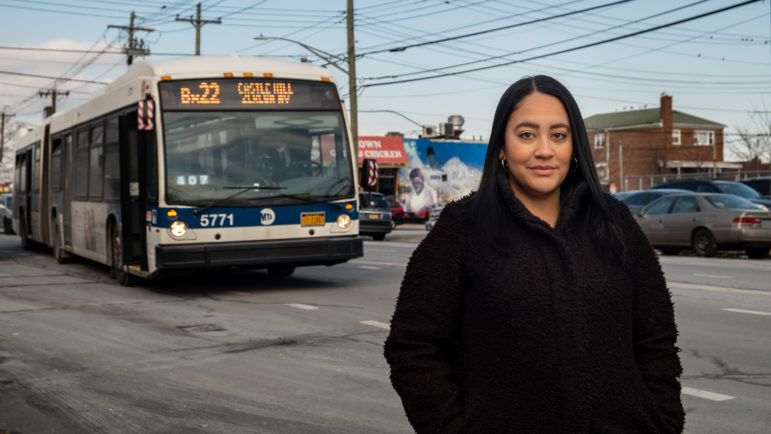
Following the 2021 elections, New York welcomed a new mayor and an almost entirely new City Council in January, its most racially diverse cohort of lawmakers ever and the first time the legislative body has been majority women. Below, a shot of new Councilmember Amanda Farías on Castle Hill Avenue in her Bronx district.
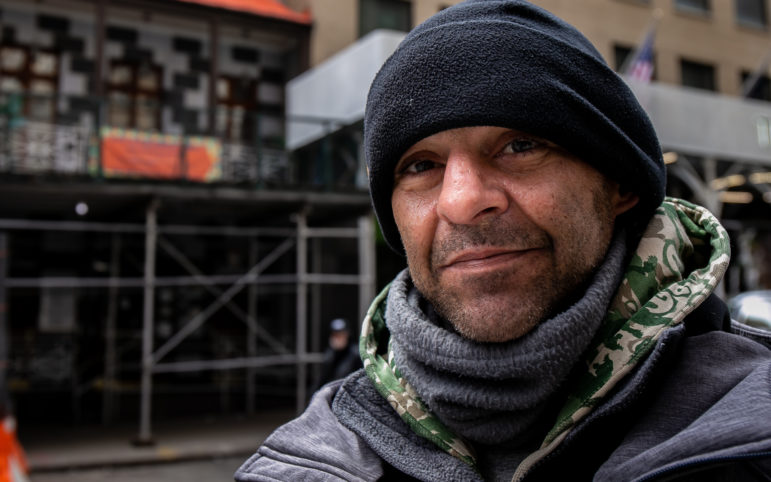
Michael Torres, pictured below, told City Limits in March that he’d recently accepted a bed in such a shelter after more than a year sleeping in parked cars and parks. “I don’t need a curfew,” he said at the time. “I just need to eat a bowl of oatmeal and go out looking for work.”
Adi Talwar
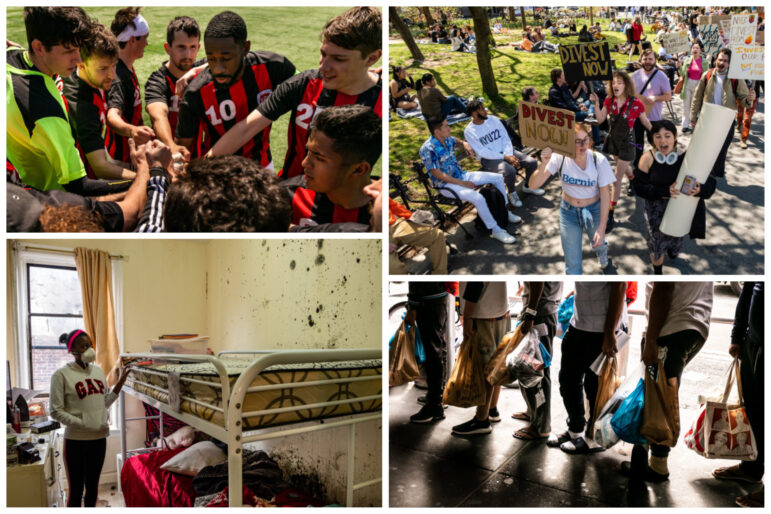
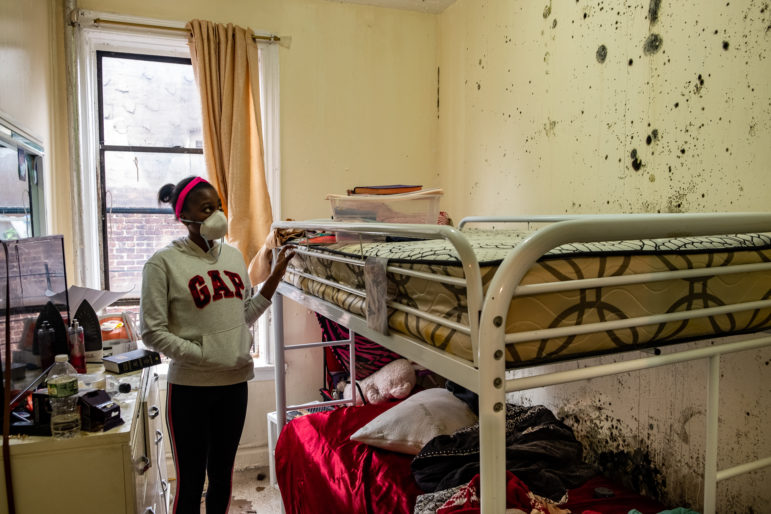
Nicholle Nichols in her Washington Heights apartment, where she had been trying for months to get the landlord to fix a persistent mold problem. Tenant attorneys, advocates and policymakers say the delays that Nichols encountered demonstrate the flaws of the city’s code enforcement program, and the limits of a housing court system that can move at a glacial pace when it comes to holding owners accountable for unsafe conditions.
Adi Talwar
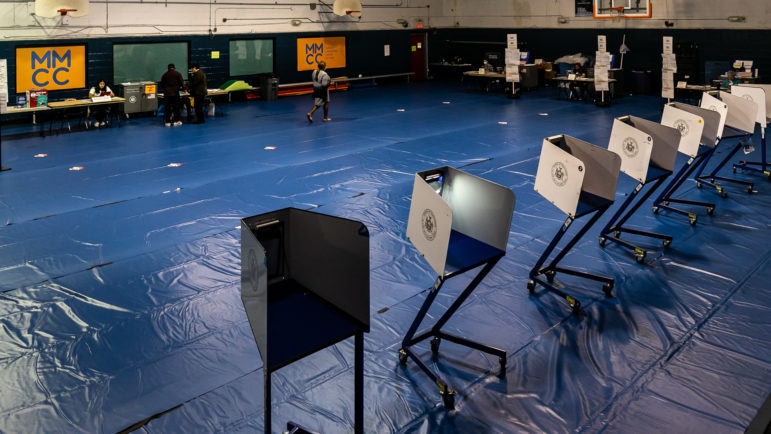
An empty polling site in The Bronx during the primary election in June, the first of two primaries held in New York state this year during a chaotic election season. Races for Congress, State Senate and Assembly were complicated by a legal battle over redistricting that threw in a wrench in many candidates’ campaign plans.
After two pandemic years that wrought havoc on all education but particularly on arts classes, advocates and educators have mounted a drive to win more—and more permanent—funding for visual art, music, dance and theater in the city’s schools. Below, images of music, dance and art classes held this year Bronx Community Charter School.
The Ukrainian Sports Club was founded in 1947 as tens of thousand of Ukrainian migrants settled in New York. Today, the team—pictured below at a match in Brooklyn’s McCarren Park in late April—competes in the historic Cosmopolitan Soccer League and continues to serve a special function for generations of immigrants, particularly this year after Russian’s invasion of Ukraine. “We are not in Ukraine and we can’t take up weapons and defend our country, but we can contribute humanitarian aid, contribute to our families there,” one team member told City Limits.
Adi Talwar
This year saw several heated debates over land use proposals across the five boroughs, as the city looks to create more housing to keep up with demand while heeding residents’ concerns over affordability neighborhood character. The City Council in 2022 approved upzonings from private developers—including plans to build new apartments for sites in Astoria (below) and Throggs Neck—as well as a city-initiated rezoning in the Rockaways. Mayor Eric Adams has also proposed neighborhood-level rezonings near future Metro-North stations in the East Bronx and along an Atlantic Avenue light manufacturing corridor in Crown Heights and Bedford-Stuyvesant.
Adi Talwar
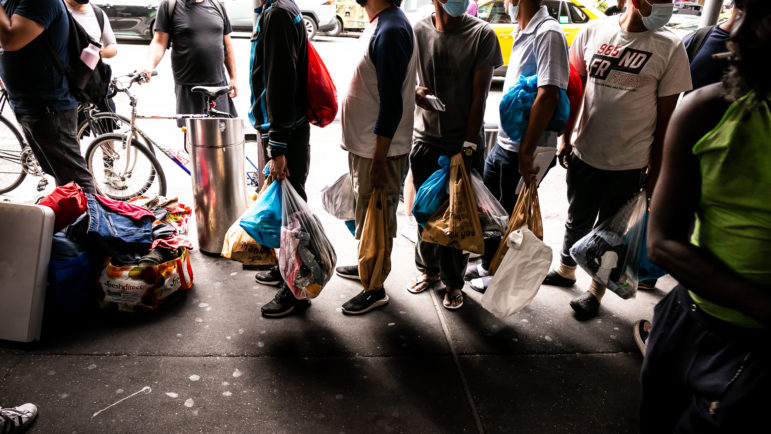
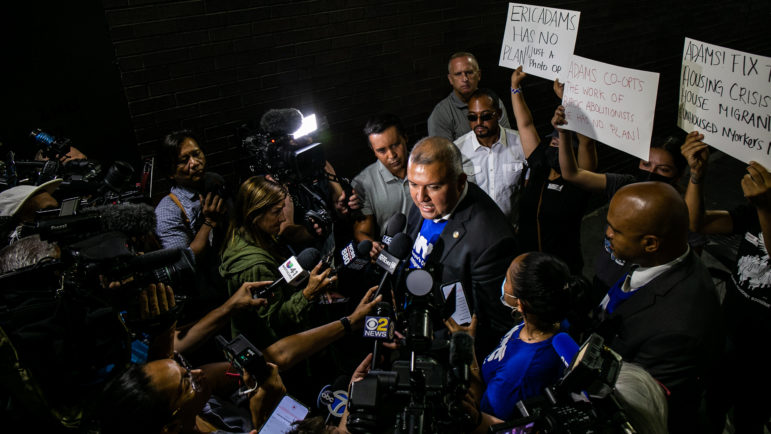
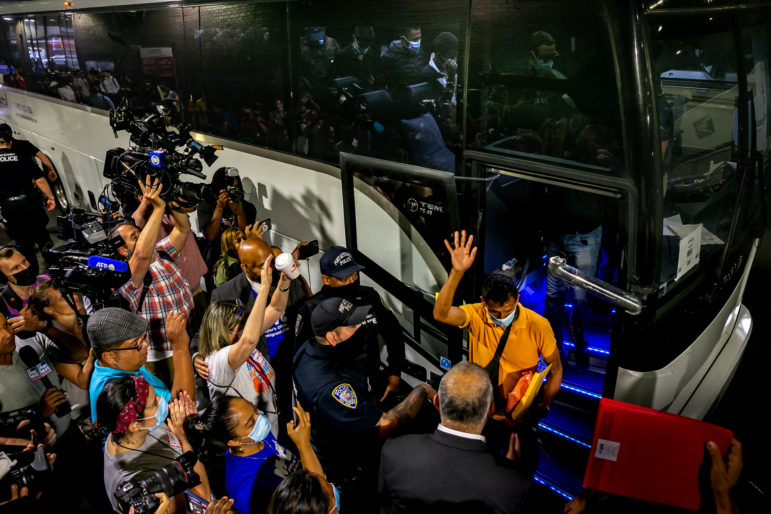
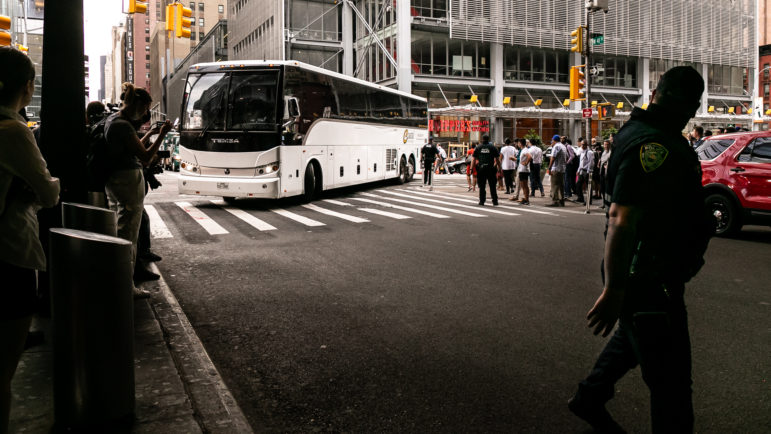
Starting in the spring, New York City saw an influx of migrants and asylum seekers from Latin America, many of whom were bused here by Republican governors in southern border states as part of a political stunt. Thousands have entered the city’s shelter system, prompting Mayor Eric Adams to declare a state of emergency. The series of images below captures the scene as one of three buses of asylum seekers from Texas arrived at the Port Authority bus terminal on Aug. 10. “I need to find a job,” Jose Rodriguez, who was staying in a Brooklyn homeless shelter this summer after arriving from Venezuela, told City Limits in Spanish. “My family is in Colombia and waiting for help.”
Immigrants who arrived in New York City on one of the three buses from Texas on Aug. 10, waiting in front of Port Authority to be transported to homeless shelters.
NYC Mayor’s Office of Immigrant Affairs Commissioner Manuel Castro addressing the press at Port Authority in Midtown Manhattan.
First person disembarking the first of three buses that arrived from Texas at Port Authority in Midtown Manhattan on Aug. 10, 2022.
The first of three buses from the Texas border arriving at Port Authority in Midtown Manhattan on Aug. 10.
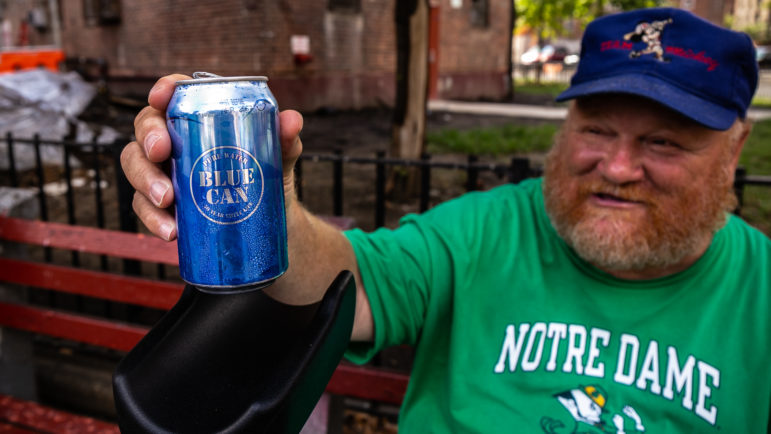
Mando Martinez, a lifelong resident of the Jacob Riis Houses, holds a can of water provided by the city after NYCHA warned tenants at the development not to drink or cook with their tap water after it tested positive for arsenic in September. The incident turned out to be a false alarm, what officials blamed on a laboratory subcontractor that inadvertently introduced arsenic into the sample, but reignited tensions and distrust between NYCHA tenants and management.
Adi Talwar
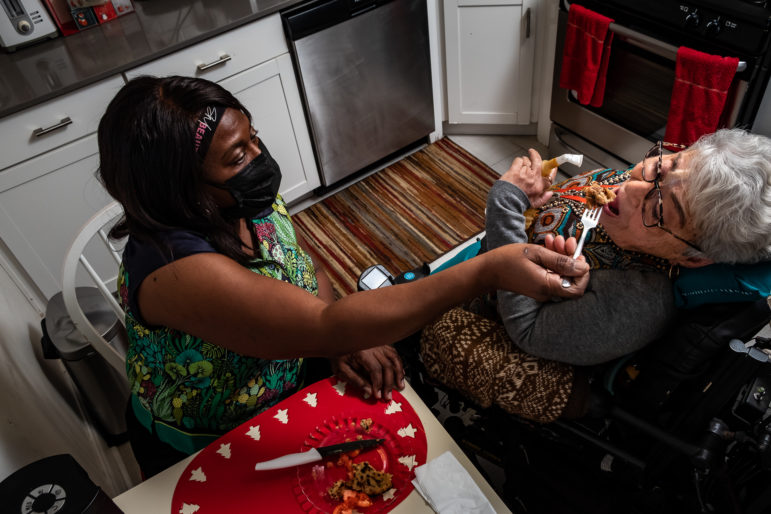
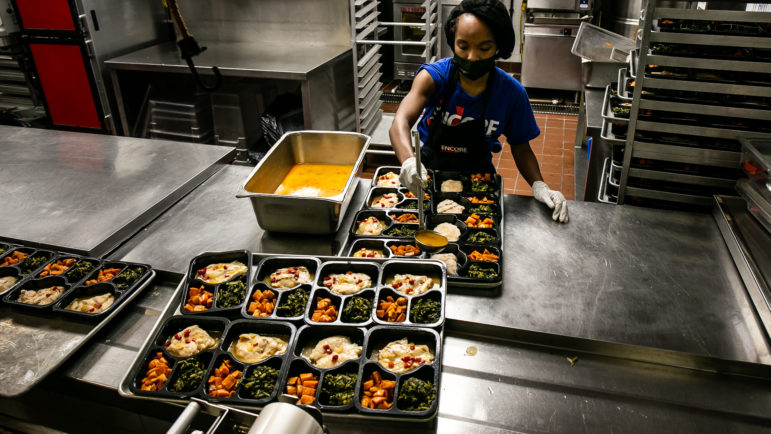
Below, a worker at Encore Community Services’ Senior Center packs meals for home delivery. This year, both the city and state budgets included funding for Cost-of-Living-Adjustments (COLA) to boost the wages for human service workers at nonprofits under contract to provide support and essential services to New Yorkers. Even with the pay bump, many nonprofit workers say their low wages make it difficult to justify staying in the sector in the face of increased costs of living and demand spurred by the pandemic.
Adi Talwar
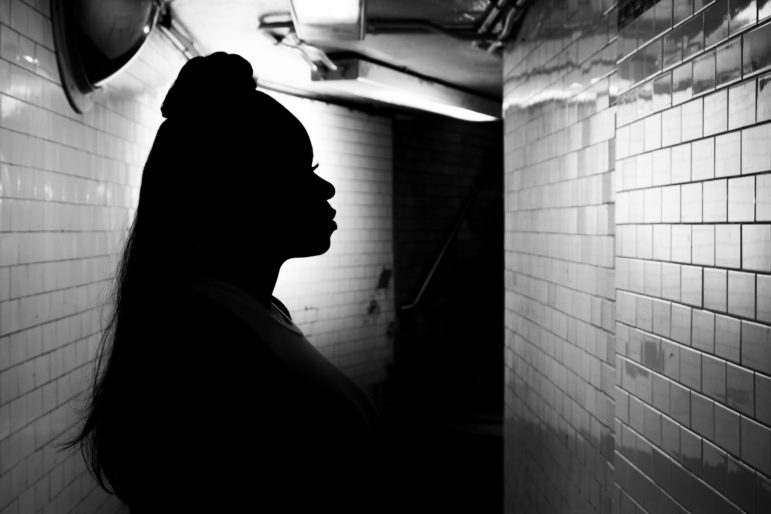
L., who asked to go by her first initial to protect her identity, spoke to City Limits this fall while she was staying at a domestic violence shelter with her son and searching for an apartment to move into after. State law caps stays in domestic violence shelters at 180 days, forcing thousands of families in recent years to enter the city’s crowded homeless shelter system when their time runs out.
Adi Talwar
“The transfer has destroyed us,” said a mother whose son, in immigration detention in New York for the last two years, was abruptly transferred from the Orange County Jail upstate to a facility in Mississippi this summer. He was one of dozens of detainees moved from the jail to other ICE facilities without notice, prompting intense criticism from advocates and immigrant families, who have called for New York State to cease contracting with ICE.
Adi Talwar
In October, Mayor Eric Adams announced the city would be opening a “Humanitarian Emergency Response and Relief Center” or HERRC to accommodate the thousands of asylum seekers who’ve arrived in the city in recent months. But the tent facility on Randall’s Island closed less than a month after it opened, following sparse use and intense criticism from advocates who criticized the lodgings as lacking privacy and adequate shelter from the elements. But facing another uptick in the homeless shelter population, city officials said this month that they might revive the model.
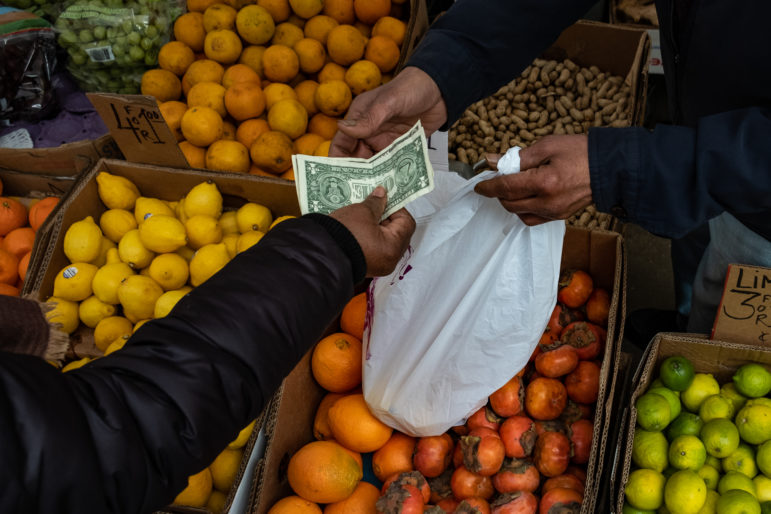
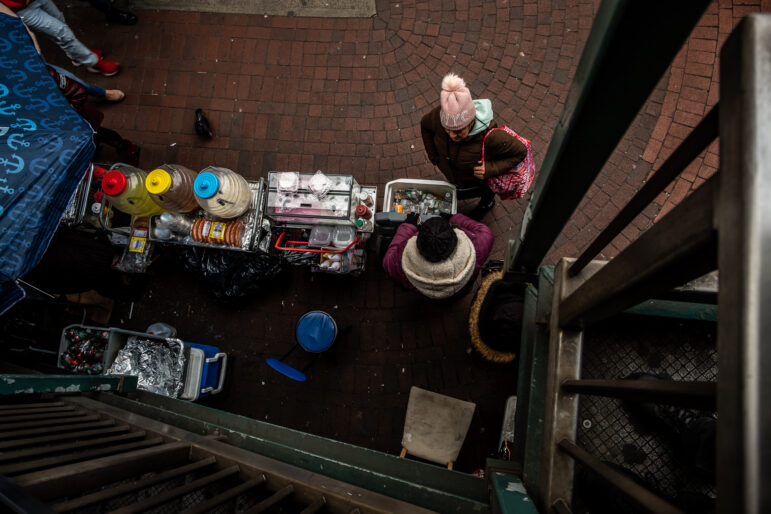
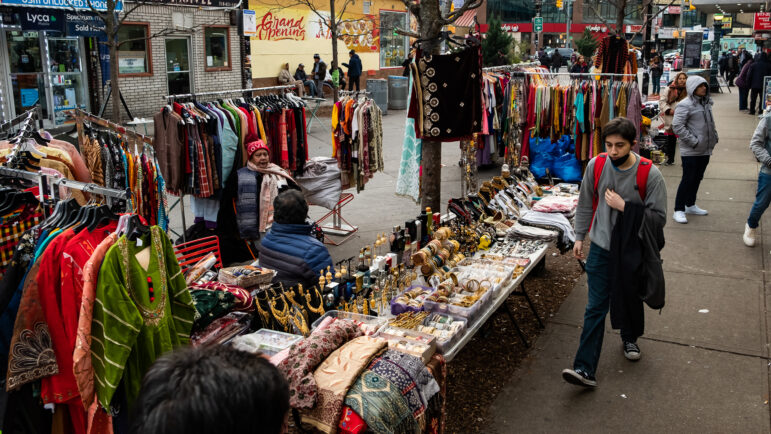
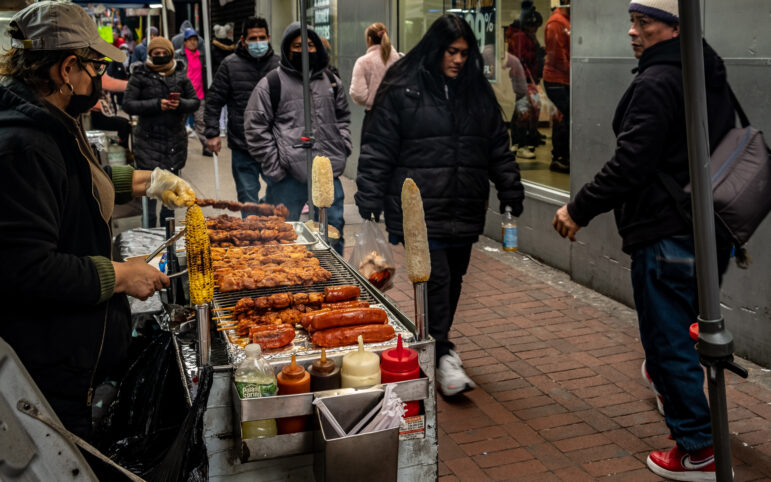
This year, the NYPD has been the leading enforcement agency against street vendors, breaking from an earlier pledge to take them out of the process as part of reforms announced by former Mayor Bill de Blasio. Police issued more tickets to vendors in 2022 by November than the Department of Consumer and Worker Protection (DCWP), a City Limits’ data analysis found, despite the fact that DCWP was put in charge of vendor enforcement last year after passage of the City Council’s street vendor reform law.
Vendors in Jackson Heights, Queens, saw the most enforcement this year by the city’s Department of Consumer and Worker Protection (DCWP), along with several other neighborhoods home to large immigrant populations.
A vendor in Jackson Heights, Queens.
A food vendor in Queens cooks up pupusas.
Street vendors near Roosevelt Avenue in Jackson Heights, Queens.
A street vendor on Roosevelt Avenue in Jackson Heights, Queens, the zip code that saw the most enforcement this year by the city’s Department of Consumer and Worker Protection (DCWP).
NYC’s Floundering ‘Right to Counsel’ Fails to Keep Pace With Eviction Cases
The city’s trailblazing program guaranteeing legal representation to the city’s poorest tenants facing eviction has been falling short since the state eviction moratorium was lifted last year; many still face housing court alone.State officials told City Limits the program has declined more than10,000 casessince March 2022.
Adi Talwar
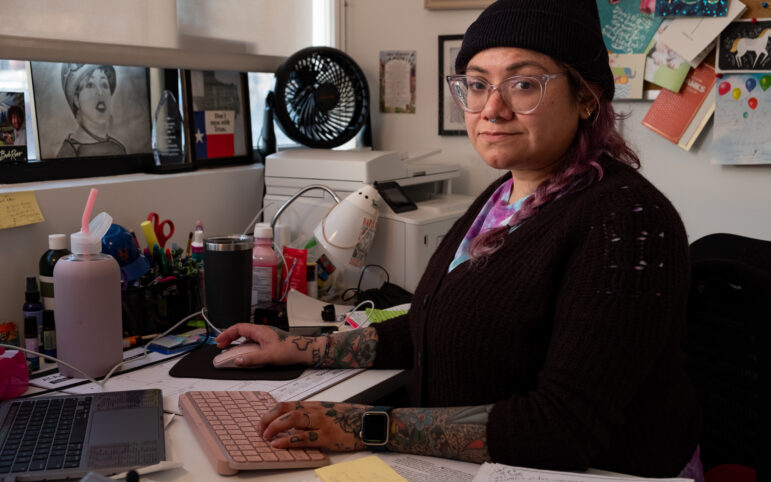
Cathy Barreda, director of the Tenant Rights Coalition at Brooklyn Legal Services in her office located in Brownsville, Brooklyn. “The court thinks that they can decide our caseloads. A lot of longtime practitioners are exhausted,” Barreda said of the current pace of eviction cases.
New York City’s Right to Counsel law was the country’s first to promise representation to the tenants most at risk for eviction: low income New Yorkers. Since it passed five years ago, Right to Counsel has begun to change eviction proceeding outcomes: 84 percent of tenants represented by a lawyer through the initiative stay in their homes, according to city officials.
Though it’s known informally as Right to Counsel, the law is officially called Universal Access to Legal Services. But over the last year, access to the benefit has been far from universal. The number of tenants who have an attorney in the city’s housing court has gone down every month since New York’s eviction moratorium ended in January of 2022, from 66 percent to just 35 percent in the first week of October, according to data tracked by housing advocates. That’s compared to the approximately 95 percent of landlords who are typically represented by lawyers in court.
“There are people who are falling through the cracks,” said Julia McNally, attorney-in-charge at the Legal Aid Society in Queens, one of 18 nonprofit organizations representing Right to Counsel-eligible tenants. “Those people—in the case of an illegal lockout—may never get restored to their apartment.”
More than 100,000 evictions were filed across the five boroughs in 2022, court data shows. That’s a steep drop from the 230,071 filed in 2017, the year that Right to Counsel passed into law, which indicates that it’s been a deterrent to eviction filings. But in every borough, there are more qualified tenants facing eviction than lawyers to counsel them.
“Since March 2022, there have been more than 10,000 cases declined and another 12,000 with limited participation by the Right To Counsel providers,” wrote Lucian Chalfen, director of public information for New York’s Office of Court Administration, via email. In that same time period, the legal service providers accepted about 21,000 cases, according to Chalfen.
Structural issues contributed to the decay of Right to Counsel in 2022, according to more than a dozen attorneys, researchers and advocates who spoke with City Limits. Nonprofit housing lawyers tend to earn lower pay and have a high turnover rate that accelerated during the COVID-19 pandemic. The courts—facing a backlog of cases—are now putting them on the calendar faster than tenants can get lawyers, and the process of eviction itself is designed to move more quickly than other civil cases.
“I get so many calls every single day, but most of the time, a law student in my class will return the call or I will myself, and we’ll do our best to give the person legal advice,” said McNally. “We’re just so constrained with our capacity that we can’t take walk-ins right now.”
A group of organizations tracking eviction and Right to Counsel data, under a project known as the NYC Eviction Crisis Monitor, reported in October that 12,776 tenants—more than half of all tenants facing eviction who have appeared in court since the moratorium ended—have been denied counsel, either because they did not qualify or because legal service providers were overburdened.
Lucy Block, a researcher at the Association for Neighborhood & Housing Development (ANHD), estimated that more than 80 percent of those tenants likely qualify for free counsel, given the income of those typically facing eviction. To qualify for a lawyer through Right to Counsel, a tenant’s household income must be within 200 percent of the federal poverty line, or $55,500 for a household of four.
Not enough information, not enough lawyers
Right now, many tenants are not aware of Right to Counsel, or how it works.
From 2018-2021, tenants, Right to Counsel providers, government officials and advocates shared knowledge and feedback at a yearly public hearing prescribed by the text of the legislation and hosted by the Office of Civil Justice. Despite the mandate and recent accessibility issues, there was no public hearing in 2022, and according to lawyers and advocates, one has still not been scheduled. A spokesperson for the city’s Department of Social Services (DSS), which oversees Right to Counsel and the Civil Justice office, did not respond to questions about the missed hearing.
“As far as housing, I only know so much,” said Mario, a self-represented Bushwick tenant in eviction proceedings, who asked City Limits to withhold his last name because he fears retaliation from his landlord. “They [judges] tell me things, and I can either agree or say I don’t understand. It was overwhelming.”
Mario says his individual income qualifies him for representation through Right to Counsel, but eligibility is based on household income, and his roommate Travis has returned to work. That prevents both of them from receiving representation, even though they aren’t related. The roommates claim to have called every legal service provider multiple times in search of assistance. They have been told that their case can’t be taken by overloaded attorneys, who have to prioritize other cases.
In a case that City Limits observed in Queens housing court on Oct. 17, landlord and first time homeowner Claudette Gouveia represented herself against a tenant who had a Right to Counsel lawyer. She said that while it’s hard to call the law beneficial as a small landlord without a large cash reserve, it doesn’t have the same impact on big landlords who are “trying to get one tenant out and have 20 more waiting on hand.”
By and large, it’s those big landlords who are most likely to be doing the evicting. Data from the housing nonprofit JustFix shows that 89 percent of all residential rental units in New York City list a corporate owner. City Limits reached out to more than a dozen city-based corporate landlords and their lawyers in an effort to get their perspective on Right to Counsel, but none responded for this story.
This fall, both Bronx and Brooklyn county courthouses displayed outdated information about Right to Counsel, from before the COVID-19 pandemic, when the program was still being phased in by zip code. During six visits to civil courts in the Bronx, Brooklyn, and Queens, City Limits met tenants who expressed confusion about where to go to get a lawyer, if they qualified for one, and what documentation they needed to provide.
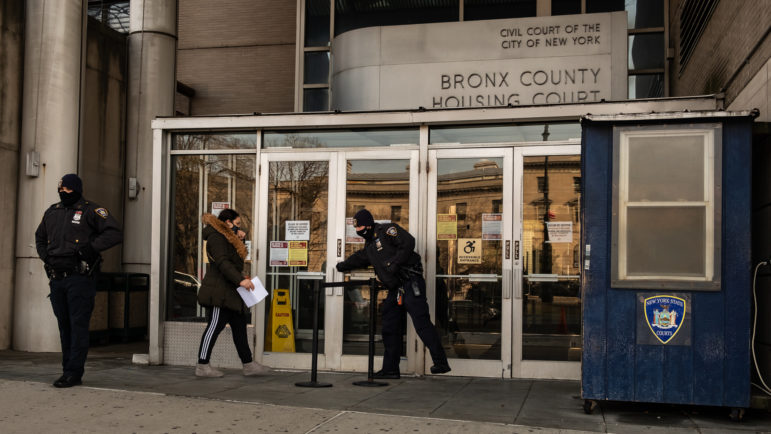
Bronx County Housing Court on Jan. 14, 2022, the day before the state’s pandemic eviction moratorium ended.
Cases moving too quickly
“We ended up with a supply chain issue,” said Andrew Scherer, the policy director of the Wilf Impact Center for Public Interest Law at New York Law School. He said that attrition is common in housing law, and he’s been working to institute programs that shepherd new lawyers into the field.
But the amount of available attorneys is only part of the problem. Scherer said that while the pace of calendaring and the lack of lawyers are important, a larger problem is the process of eviction itself, and how many people face it. Summaryeviction proceedings were originally designed to move more quickly than other types of cases, Scherer explains, an effort to help landlords seize back their property through legal means.
“The courts have not been cooperative enough,” Scherer said. “It’s interesting that they were able to shut it [court] down because of COVID for a long period of time, and then suddenly they opened it up, and it’s as if there’s this incredible sense of urgency that everything has to now keep moving.”
During the COVID-19 pandemic, New York City courts created new intake parts, rooms in which qualified tenants can be matched with Right to Counsel lawyers, to speed up the process. But faster matching without more lawyers was one cause of several legal service providers halting intake for periods of time last spring. Managing attorneys at Legal Services NYC, the Legal Aid Society, and The Bronx Defenders—three of the city’s largest Right to Counsel providers—have all said they’ve had to turn down cases due to the pace of calendaring.
“In the Bronx, we’ve been seeing between 110 and 120 cases being calendared a day,” said Runa Rajagopal, managing director of civil action practice at The Bronx Defenders. “A lot of people are showing up, asking for representation, and their cases are moving forward whether or not they have a lawyer.”
Since last spring, legal providers have called for the city’s housing courts to slow down the speed of cases so they can better keep up with capacity. But that request is at odds with the perspective of many property owners, who are looking to move eviction cases along after the state’s pandemic moratorium halted the proceedings for nearly two years, and as New York’s COVID Emergency Rental Assistance Program (ERAP) has failed to keep up with demand.
“No one has provided owners any deferral or relief from the payment of property taxes or water bills. Insurance and mortgage payments are still due,” the city’s Rent Stabilization Association, which represents some 25,000 landlords, said in testimony to the New York City Council last year about the impact of the eviction moratorium. “There needs to be greater access to the courts.”
In response to questions about the pace of case calendaring, Chalfen of the OCA wrote that: “While we support the idea that as many litigants as possible in eviction proceedings should have attorneys, the Court system is not denying litigants counsel in Housing Court. The inability of the Right To Counsel providers to staff intake calendars is the real reason.” He also referenced “numerous laws and regulations…dictating case movement,” that guide the court’s calendaring speed.
A spokesperson from New York’s Department of Social Services (DSS), which oversees Right to Counsel through its Office of Civil Justice, wrote that it continues to work with legal service providers and the OCA to “ensure that New Yorkers who are entitled to free legal counsel as part of the City’s Right to Counsel program are connected to the supports they need and deserve.”
The city is also working to identify more legal service providers—and thus more lawyers—to add to the program.
Twelve of the initiative’s 18 legal service providers currently list open housing attorney positions on their websites. According to these listings, salaries start at $62,000-$73,000 yearly, which is significantly less than attorneys could make practicing other types of law. Forbes estimates that the average salary for a lawyer in New York state is more than $167,000. And money isn’t the only issue.
“There’s sort of this thing about people not being tough enough,” said Cathy Barreda, a steering committee member of the Right to Counsel NYC Coalition and the director of the tenant Rights Coalition at Brooklyn Legal Services. “So I think the morale is just so incredibly low.”
Barreda says even though her union has a cap of 40 active cases, lawyers go above that limit, and it can be hard to define which cases are active.
“The court thinks that they can decide our caseloads. A lot of longtime practitioners are exhausted. [They] didn’t want Right to Counsel to begin with because they didn’t want it to turn into criminal public defense work,” said Barreda.
Like public defenders, the work of nonprofit housing attorneys often expands beyond their court-related duties, and they represent tenants regardless of the merit of their cases. Legal service providers say the Right to Counsel program doesn’t pay for paralegals or social workers, which means the lawyers have to spend time submitting ERAP applications and applying for housing vouchers, on top of their regular judicial work.
Additional resources could help the program reach more tenants early on, and provide them with that type of assistance in order to avoid eviction proceedings altogether, further freeing up the housing court pipeline.
“There’s a whole host of people who should never be in court,” said Rajagopal. “[They] could get financial assistance, may have matters that should have been resolved, but just end up in the court system.”
In early October, Manhattan Borough President Mark Levine and Bronx Borough President Vanessa Gibson called for a freeze on eviction proceedings when tenants can’t find a lawyer.
Despite the pile up of cases, the council members, alongside the Right to Counsel Coalition, are pushing for the expansion of Right to Counsel to cover people who are above 200 percent of the federal poverty line, but don’t make enough money to hire a lawyer on their own.
“I think it’s rewiring ourselves to see that value on an individual basis, but also from a broader perspective,” said Rajagopal. “We’ve never faced this kind of challenge where we have this hard fought, hard won, beautiful law on the books. It could be more; it could be better, right?”
Opinion: Feds Can Further ‘Fair Housing’ Goals by Adequately Funding NYCHA
“If NYCHA is so dependent upon federal funding, doesn’t the federal government have, not just a moral, but a legal obligation to adequately fund federal housing?”
Adi Talwar
The Hope Gardens NYCHA development in Bushwick.
Public housing in New York City is a critical lifeline to many low- and moderate-income New Yorkers. There are certain facts about NYCHA that are, indeed, astonishing. For example, NYCHA developments house at least 339,900 people, which amounts to 3.9 percent of New York City’s entire population. Rents are adjusted with income, which means that even when residents face economic hardship—for example, due to illness or loss of a job—they have the ability to keep their rent affordable and avoid housing instability or eviction. NYCHA has also been a leader and model of innovation in various fields, including energy efficiency, climate resiliency, and waste management.
But there is no denying that NYCHA has been plagued with problems of immense proportion. Things became so dire that, in 2019, NYCHA entered into a settlement agreement with the U.S. Department of Housing and Urban Development (HUD) after federal prosecutors alleged that NYCHA was systematically failing to maintain its properties in a safe and sanitary manner. They also alleged that NYCHA had engaged in deceptive practices regarding the existence of lead-based paint in its apartments with children living in them. Since then, while NYCHA has made incredible efforts and steady progress, grave and systemic problems remain.
I briefly worked at NYCHA as special counsel in the Office of Strategy & Innovation, a small unit whose mission is to develop and implement the transformative changes required by the HUD agreement. This position allowed me to see first-hand how a significant portion of NYCHA’s ongoing problems stem from two things: first, NYCHA’s portfolio comprises aging and deteriorating housing stock, and second, NYCHA lacks the funding to undertake wholesale modernization efforts across its portfolio. In fact, in 2017, NYCHA determined that it would need $45.2 billion to adequately meet its capital needs over the next 20 years. That is money that it simply does not have.
NYCHA receives funding from various sources. A central component, however, comes from the federal government. Specifically, NYCHA receives about 60 percent of its operating budget and 50 percent of its capital budget from federal funding. Yet federal investment in public housing has steeply declined since the 1970s, as there was a political push away from public housing and toward privatization. Since 2000 alone, there has been a 17 percent decline in public housing funding from the federal government. The decline has forced NYCHA to think of creative methods to close the funding gap by converting developments from public housing to a form of Section 8, whether through the RAD/PACT program or the New York City Public Housing Preservation Trust. Those options, however, are complex and have engendered some controversy.
My time at NYCHA and background as a litigator led me to question: If NYCHA is so dependent upon federal funding, doesn’t the federal government have, not just a moral, but a legal obligation to adequately fund federal housing?
NYCHA developments fit this description. According to data current through March 2022, 43 percent of NYCHA’s families identify as Black, and 45 percent identify as Hispanic; 42 percent of public housing families survive on a fixed income, and over 12 percent receive public assistance. Moreover, many NYCHA developments are located in areas that could be considered lower-opportunity, meaning that they are far from cultural and commercial hubs and are located in areas with relatively high crime and poverty rates.
And while HUD is not intentionally discriminating against NYCHA residents (and, in fact, has many smart, dedicated, and hardworking public servants who fight daily to improve life for NYCHA residents), its inability to adequately fund public housing is nevertheless disproportionately impacting Black and Latinx New Yorkers. The failure to adequately fund public housing is, therefore, arguably, the failure to take meaningful action to affirmatively further fair housing.
Of course, HUD does not allocate its own funding, so while it may be responsible on paper, it is not necessarily to blame. Funding is Congress’s responsibility. Yet when it comes to obligations mandated by federal law, strained resources may not be a defense. Recently, Chief Justice John Roberts noted in an argument regarding federal immigration enforcement that it’s the Judicial Branch’s “job to say what the law is, not whether or not it can be possibly implemented or whether there are difficulties. . . I don’t think we should let [the Executive Branch] off the hook.”
The courts, thus, have a role to play in the fight for fair housing. Specifically, they have the ability to declare that the failure to provide sufficient funding to NYCHA to allow it to meet its operating and capital needs is inconsistent with the obligations imposed by the Fair Housing Act. If Congress won’t voluntarily fund public housing, there may be an opportunity for courts to “say what the law” is to help ensure that NYCHA residents have safe and habitable homes.
Andrew Darcy is a supervising attorney in the Housing Project at Mobilization for Justice, Inc., where he represents tenants in eviction proceedings and in matters relating to the Fair Housing Act.
Vendedores ambulantes de la ciudad recibieron el doble de multas este año en comparación con los niveles pre-pandemia
En 2019, cuando la policía de Nueva Yorkera el único encargado, emitió 1.812 multas frente a 2.499 en los primeros nueve meses de este año, con casi la mitad (48.6 por ciento) repartidas en el último trimestre. En solo nueve meses, la policía de Nueva York y el Departamento de Protección al Consumidor y al Trabajador (DCWP por sus siglas en inglés) emitieron 3.884 multas a vendedores, más del doble de la cantidad de multas emitidas en 2019.
Adi Talwar
Vendedor ambulante en Roosevelt Avenue en Jackson Heights, Queens, el código postal que tuvo la mayor cantidad de multas este año por parte del Departamento de Protección al Consumidor y al Trabajador de la ciudad (DCWP por sus siglas en inglés).
Este artículo apareció originalmente en inglés. Translated by Daniel Parra.
Este año, la policía de Nueva York (NYPD por sus siglas en inglés) ha sido el principal organismo encargado de hacer cumplir la ley contra los vendedores ambulantes, rompiendo con una promesa anterior de eliminarlos del proceso como parte de las reformas anunciadas por el exalcalde Bill de Blasio.
La policía ha puesto más multas a vendedores en 2022 que el Departamento de Protección al Consumidor y al Trabajador (DCWP por sus siglas en inglés), según un análisis de datos de City Limits, a pesar de que el DCWP se hizo cargo de la aplicación de la ley el año pasado tras la aprobación de la ley de reforma de los vendedores ambulantes del Concejo de la Ciudad. Ese cambio fue codificado en una orden de operaciones emitida a los agentes de policía a principios de 2021, que aconsejaba evitar tomar medidas relacionadas con la vigilancia de los vendedores “en ausencia de circunstancias exigentes”.
La cantidad de multas emitidas a vendedores ambulantes en los primeros tres trimestres de 2022 también ha aumentado, superando con creces lo que se vio en el año anterior a la pandemia (City Limits está comparando las cifras de este año con las de 2019, ya que ese fue el último año completo pre COVID-19. La ciudad multaba activamente a los vendedores, pero la pandemia detuvo la mayor parte de la aplicación de la ley en 2020. Durante la primera mitad de 2021, cuando el DCWP pasó a hacerse cargo, el foco era la divulgación y educación de los vendedores ambulantes en lugar de emitir multas).
En 2019, cuando la policía era el único encargado, la policía emitió 1.812 multas, frente a las 2.499 emitidas en los primeros nueve meses de este año, con casi la mitad (48,6 por ciento) repartidas en el último trimestre, según un análisis de los informes trimestrales del departamento de policía de Nueva York.
Mientras tanto, DCWP emitió 1.385 multas en los primeros tres trimestres de 2022. En solo nueve meses, las dos agencias de la ciudad emitieron 3.884 multas, más del doble de la cantidad de multas emitidas a los vendedores durante 2019.
“Aunque la responsabilidad principal está a cargo del Departamento de Protección al Consumidor y al Trabajador, la policía de Nueva York mantiene su autoridad para hacer cumplir todas las infracciones y los oficiales usan un alto nivel de discreción”, dijo un portavoz de la policía, y agregó que trabajaron con la oficina del alcalde en la transición, que incluyó la disolución del grupo de trabajo de vendedores ambulantes del NYPD.
Durante años, los vendedores ambulantes y sus defensores han estado presionando para eliminar la participación de la policía en la aplicación de la ley, argumentando que la práctica es demasiado punitiva contra una industria compuesta en gran parte por inmigrantes neoyorquinos y personas de color.
“Queremos ver a la policía de Nueva York completamente fuera de esto”, dijo la concejal Shahana Hanif, presidenta del comité de inmigración.
El número limitado de permisos actualmente disponibles, dicen los defensores, ha hecho que sea casi imposible para la mayoría de los vendedores ambulantes operar legalmente, obligando a muchos a pagar miles de dólares por permisos en el mercado negro para continuar trabajando.
“La ciudad ha creado un problema artificial de escasez al limitar la cantidad de licencias”, dijo el concejal Shekar Krishnan, cuyo distrito de Jackson Heights vio a la mayoría de sus vendedores ambulantes inspeccionados y multados por DCWP tanto este año como el año pasado. “La legalización del trabajo [de los vendedores] y el reconocimiento de su importancia para la ciudad de Nueva York están muy retrasados. ”
Adi Talwar
Un vendedor de pupusas en Queens.
¿Dónde se rompen las reglas?
NYPD no desagrega la cantidad de multas que emitió a los vendedores ambulantes por código postal, pero el DCWP sí lo hace. Desde que la agencia comenzó a repartir multas, Jackson Heights (código postal 11372) ha sido el área con mayor número de multas para los vendedores tanto en 2021 como en 2022, aunque no se encuentra entre los cinco códigos postales que reciban más quejas por la presencia de vendedores ambulantes.
Top Códigos Postales para Quejas for Complaints
# de Quejas
Top Códigos Postales para Inspecciones
# de Inspecciones
Top Códigos Postales para Multas
# de Multas
10001
1,185
11372
915
11372
147
10004
611
11220
656
10036
84
10007
481
11354
590
10001
67
10005
401
11368
571
11368
55
10019
304
11355
395
10003
54
Códigos postales que registraron el mayor número de denuncias de vendedores, inspecciones y multas del DCWP en 2022 hasta la fecha.
En el pasado, el DCWP ha argumentado que la aplicación de la ley es a menudo una respuesta a las quejas del público en general, los funcionarios electos, las juntas comunitarias y los distritos de mejora comercial, que se han enfrentado con los vendedores por cosas como la basura, las aceras bloqueadas y su impacto potencial en las pequeñas empresas de ladrillo y mortero.
La ciudad recibió más quejas sobre vendedores ambulantes este año en comparación con el anterior: hubo 4.736 quejas de vendedores en 2021 frente a 7.081 en los tres primeros trimestres de 2022.
Sin embargo, solo uno de los códigos postales con más quejas este año está entre los cinco primeros con multas, lo que pone de relieve la diferencia observada en otros análisis de datos entre dónde se originan las quejas y dónde se reparten las multas. Cuando se le preguntó al respecto, el portavoz de DCWP, Michael Lanza, explicó que las multas son el resultado de violaciones de la ley.
“La cantidad de inspecciones que resultan en multas depende de si el proveedor cumple con las reglas y detiene cualquier conducta ilegal identificada durante la inspección, ya que DCWP emplea un enfoque de educación primero”, agregó. “DCWP emite más citaciones en las áreas donde los vendedores se niegan a seguir las instrucciones de los inspectores”.
Vendedores ambulantes como Cleotilde Juárez, de 31 años, dijeron que no han visto el enfoque de educación de DCWP en Jackson Heights, donde trabaja vendiendo chalupas poblanas, una comida callejera icónica de Puebla, México.
“Eso no es cierto”, dijo Juárez. “Ellos [DCWP] vienen y dicen: ‘Dame tu identificación y toma tu multa’. Ellos no son los que educan. No. Son las organizaciones”.
Condado
Quejas
Inspecciones
Multas
BRONX
432
1202
107
BROOKLYN
1018
2502
232
MANHATTAN
4625
336
611
QUEENS
868
3514
433
STATEN ISLAND
26
13
2
Quejas, inspecciones y multas por condado del DCWP en lo que va del 2022.
Manhattan vio la mayor cantidad de quejas y multas en comparación con los demás condados de la ciudad de Nueva York, seguido de Queens. Dos códigos postales de Queens, 11372 y 11368, que abarcan Jackson Height y Corona, representaron casi la mitad (46 por ciento) de todas las multas (433) del condado de Queens para este año. Ambos barrios son conocidos por su amplia y variada oferta gastronómica, lo que, según sus partidarios, favorece a los comercios locales.
“Tanto los neoyorquinos como los turistas de todo el mundo reconocen a Jackson Heights y Corona como ‘destinos gastronómicos’, lo que da lugar a toda una economía de recorridos gastronómicos, eventos culturales, atrayendo tráfico peatonal y comercio al área”, dijo Carina Kaufman-Gutiérrez, subdirectora del Proyecto de Vendedores Ambulantes (SVP).
La congresista Alexandria Ocasio-Cortez, quien representa a ambas áreas, dijo que “los vendedores ambulantes en comunidades de inmigrantes como Jackson Heights han enfrentado un hostigamiento histórico por parte de la policía de Nueva York por tratar de ganarse la vida honestamente alimentando a sus comunidades”.
“Es muy alarmante que DCWP continúe llevando a cabo prácticas policiales, complicando la vida de los vendedores al disminuir sus ingresos diarios y ahogándolos con fuertes multas mientras los vendedores siguen sujetos a la vigilancia excesiva por parte de la policía de Nueva York”, dijo la legisladora en un comunicado.
Adi Talwar
Vendedores ambulantes cerca de Roosevelt Avenue en Jackson Heights, Queens.
Inmigrantes inspeccionados
Los barrios con gran población inmigrante también siguen estando entre los más inspeccionados por DCWP desde 2021, como ya informó City Limits, pero este año Queens está en el centro de ellos. Esto supone un cambio respecto al año pasado, cuando Manhattan fue el distrito más inspeccionado.
Los cinco códigos postales con la mayor cantidad de inspecciones por parte de la agencia en 2022 son barrios con una gran población de inmigrantes, y ninguno de estos está en el top de las quejas. La zona más inspeccionada, Jackson Heights, tuvo más inspecciones (915) que denuncias en todo el condado (868).
DCWP reiteró que las inspecciones no se desencadenan exclusivamente por quejas, aunque no dieron detalles sobre qué más desencadena una inspección. “DCWP realiza inspecciones en áreas donde los proveedores operan con frecuencia y en respuesta a las quejas que recibimos”, dijo Lanza.
Sin embargo, el presidente del condado de Queens, Donovan Richards, calificó el patrón de inspección como una “política xenófoba”.
“¿Por qué hay este exceso de aplicación de la ley en estas comunidades?”, dijo. “La criminalización no es la forma de abordar la pobreza”.
Tanto el año pasado como este año, Manhattan ha sido el epicentro de las quejas, generando más del 65 por ciento en 2022, con cinco veces más quejas que Queens y más de cuatro veces que Brooklyn, según datos de DCWP.
Pero Queens ha sido hasta ahora el condado más inspeccionado (3.514). Una de cada tres inspecciones de la DCWP tuvo lugar en Queens, según los datos.
“A pesar de que la mayoría de las quejas se concentraron en Manhattan, los datos revelan que las prioridades de DCWP no son los códigos postales ricos sino las comunidades vulnerables de inmigrantes de clase trabajadora”, dijo Ocasio-Cortez.
“Si nuestras comunidades de Queens no constituyen la mayoría de las quejas de venta ambulante, ¿por qué DCWP está utilizando sus recursos para emitir la mayor cantidad de multas e inspecciones aquí que en cualquier otro lugar de la ciudad?” , dijo Ocasio-Cortez en un comunicado. “La DCWP debería aclarar el razonamiento que subyace a sus directivas de control desproporcionado”.
Frustraciones de los residentes
Sin embargo, la concejal Marjorie Velázquez, que preside la Comisión de Protección de los Consumidores y los Trabajadores, afirmó que DCWP se toma en serio las quejas de los consumidores y trabaja para garantizar que los vendedores ambulantes -que llevan mucho tiempo contribuyendo a la economía de la ciudad- rindan cuentas, especialmente los que infringen la ley.
Adi Talwar
Un vendedor en Jackson Heights, Queens.
“Como presidente del Comité de Protección al Consumidor y al Trabajador, debo actuar en el mejor interés de nuestra comunidad, y eso significa apoyar a los vendedores legales mientras trabajo con DCWP para garantizar que todas las partes rindan cuentas”, dijo Velázquez.
Otros legisladores señalan problemas de calidad de vida asociados con la venta ambulante que, según ellos, justifican una amplia aplicación de la ley. Dos códigos postales que forman parte de Flushing (11354 y 11355) también tuvieron más inspecciones que todas las quejas en Queens.
“Una de las quejas más comunes que recibe mi oficina es sobre la proliferación de vendedores ambulantes sin licencia en el centro de Flushing”, dijo la concejal Sandra Ung, quien enfatizó que sus declaraciones solo se aplican al distrito que representa y no pretenden reflejar la aplicación de la ley en otros barrios
“Se ha convertido en un problema de seguridad pública, desde personas con problemas de movilidad que ya no pueden caminar por las aceras hasta los riesgos para la salud de la venta no regulada de comida de mar aún viva en las calles de la ciudad. Además, muchos de los vendedores más grandes venden productos falsificados y bloquean los cruces peatonales, las bocas de incendio y las paradas de autobús y metro”, agregó Ung.
Según Ung, DCWP ha alentado el cumplimiento en Flushing, recurriendo a las multas solo cuando esos esfuerzos se han agotado o para los infractores reincidentes. “La aplicación de la ley que DCWP emprende en el centro de Flushing es una respuesta a las frustraciones de los residentes en el único distrito de mayoría asiática en el Concejo de la ciudad”, dijo.
Para la concejal de Flushing, el bajo número de quejas enviadas al DCWP desde su distrito no significa que la venta no sea un problema allí, pero puede atribuirse a la falta de confianza en el gobierno y las barreras del idioma. “Las quejas registradas oficialmente son históricamente bajas en comunidades de inmigrantes con una gran cantidad de residentes con dominio limitado del inglés que se sienten incómodos usando los canales oficiales del gobierno”, dijo Ung, y agregó que ella patrocinó dos leyes para mejorar el acceso al idioma para personas con dominio limitado del inglés que necesiten llamar al 311
La venta ambulante ha sido objeto de acalorados debates en Flushing durante años. En 2018, el entonces concejal Peter Koo patrocinó una legislación que creó zonas de no venta en el centro del vecindario. Pero los defensores argumentan que las multas y las áreas de tolerancia cero no son soluciones.
“En un momento en que la recuperación económica para los inmigrantes y las personas de color de bajos ingresos parece ser de suma importancia para la ciudad, es inaceptable que los vendedores ambulantes sigan siendo criminalizados por hacer un servicio público y operar negocios honestos”, dijo Mohamed Attia, director general de SVP. “En realidad, los vendedores son parte de lo que mantiene segura a nuestra ciudad. Son los ojos en la calle, son constructores de comunidades y vecinos”.
Attia se sumó a quienes piden que la ciudad avance en la aplicación del proyecto de reforma de la venta ambulante del Concejo, la Ley Local 18, que se suponía iba a empezar a aumentar el número de permisos de venta este verano. Pero no se ha concedido ningún permiso más de cinco meses después de lo prometido.
“Estos datos demuestran lo desequilibrada que está la estrategia municipal con respecto al sector de la venta ambulante”, afirma Attia. “Solo se está invirtiendo en hacer cumplir la ley, y no en aplicar la Ley local 18”.
La senadora estatal Jessica Ramos patrocinó un proyecto de ley a principios de este año que habría eliminado por completo el límite de permisos y que dejaría sin efecto las condenas anteriores por delitos de venta ambulante que afectan especialmente a los inmigrantes. Pero la ley no se aprobó en la sesión legislativa más reciente, empujando este tema para que se debata nuevamente en Albany en 2023.
“La ciudad debería abordar el meollo de la cuestión y comprometerse a elevar sustancialmente el límite de permisos para satisfacer la demanda real de los vendedores que se encuentran en una situación desesperada”, dijo Ocasio-Cortez.